USDA Loans in the SC Lowcountry (2026): How Some Buyers Get In With $0 Down — and the Income Limit Just Went Up
A USDA loan is a mortgage backed by the U.S. Department of Agriculture's Rural Development program, and it's one of the only loans left that lets a qualified buyer purchase a home with $0 down. It's not for farms — it's for ordinary primary homes in areas USDA has designated as rural.
Here's what most Lowcountry buyers don't realize: a lot of the growing areas just outside Charleston — the more rural stretches of Berkeley, Dorchester, and Colleton counties — are USDA-eligible. Eligibility is set by the exact address, not the town, and you can check yours in about a minute on the USDA map.
And the timing matters: USDA raised its 2026 income limits (effective July 13, 2026). For most counties, a household of 1–4 can earn up to $122,800 and a household of 5–8 up to $162,100 — so more working families qualify now than did a year ago. Send me an address and I'll tell you plainly whether it's eligible and whether your income fits.
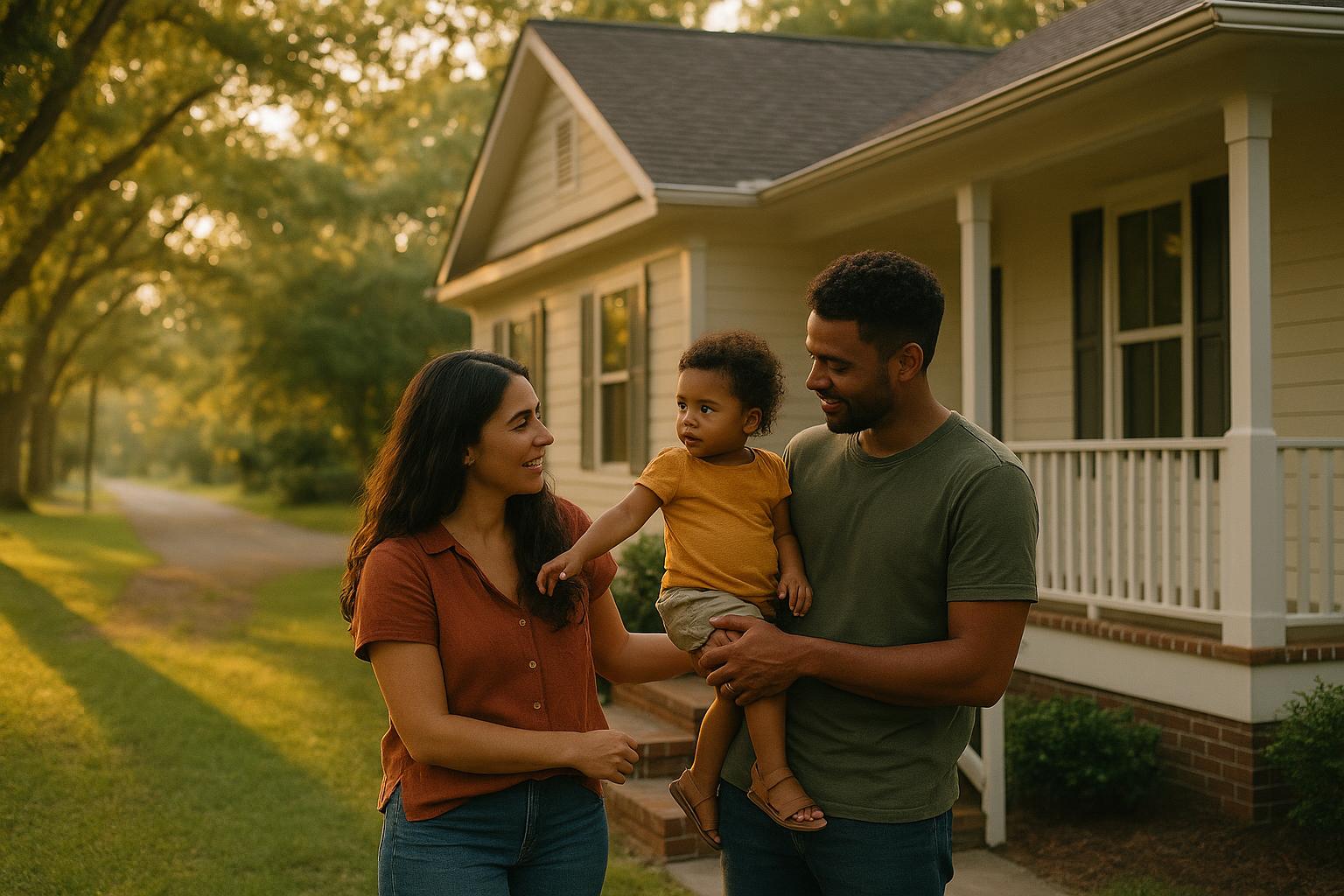
A young couple told me last fall they'd "already ruled out the no-down-payment loan" because, as they put it, "we're not buying a farm." They were renting twenty minutes outside town, both working, one baby, and they'd quietly talked themselves out of the exact program that fit them best. The home they eventually liked was USDA-eligible. Their income was under the limit. They could have bought with nothing down — and nobody had ever told them USDA was even an option. That conversation is why I'm writing this one.
What a USDA loan actually is (it's not about farmland)
Let's clear up the name first, because the name is the whole problem. "USDA" makes people picture tractors and acreage. What it actually means is that the loan is backed by the U.S. Department of Agriculture's Rural Development program — a program built to help people buy ordinary homes in less-dense areas.
Like a VA loan, the USDA doesn't hand you the money. A regular lender makes the loan, and the USDA guarantees part of it. That guarantee is what makes the rest possible:
- No down payment required on an eligible home — true $0 down, for a regular house.
- Lower monthly costs than you'd expect — the annual fee is typically less than FHA's monthly mortgage insurance.
- Built for everyday buyers — it's aimed at low-to-moderate-income households, with an income limit (more on that below) rather than a wealth test.
- For your primary home — a place you'll actually live, not an investment property or vacation home.
In other words, it's a program designed for exactly the kind of buyer who feels priced out right now: a working household that can comfortably handle a monthly payment but hasn't been able to save a pile of cash for a down payment.
Is my area eligible? (How to check in 60 seconds)
This is the part worth being careful about, so I'm going to be straight with you: eligibility is decided by the exact property address, not by the town it's in. Two homes on the same road can get different answers. So I'm not going to promise you that any particular suburb qualifies — that's exactly the kind of thing that gets people's hopes up wrongly.
What I can tell you honestly: in the Charleston area, the denser parts of the metro generally do not qualify — places like Goose Creek, most of Summerville, and the closer-in neighborhoods are usually too populous. The pockets that do tend to qualify are the more rural stretches of Berkeley, Dorchester, and Colleton counties, and plenty of the growing edges where young families are actually finding homes they can afford.
The good news is you never have to guess. Here's the 60-second check:
- Go to the USDA property eligibility map: eligibility.sc.egov.usda.gov
- Choose "Single Family Housing Guaranteed."
- Type in the full property address.
- The map tells you right there whether that address is in an eligible area.
Or just send the address to me and I'll check it for you and tell you what it means. That's a thirty-second favor, not a commitment to anything.
The 2026 income limits, in plain numbers
USDA is for low-to-moderate-income households, so there's a cap on how much your household can earn — and the cap just went up. On July 13, 2026, USDA published higher 2026 income limits for the Single-Family Housing Guaranteed Loan Program. For most counties, the numbers now look like this:
- Household of 1–4 people: up to $122,800
- Household of 5–8 people: up to $162,100
A few honest footnotes, because the details decide whether this works for you:
- Some counties differ. Those figures apply to most of South Carolina, but certain areas use a different limit. Always confirm the exact number for your county and household size on the USDA eligibility site — or ask me and I'll pull it.
- It's household income, counted USDA's way. USDA looks at the income of the adults in the household, and there are some adjustments and deductions that work in your favor. If you're a little over on paper, it's still worth running — the real number is often lower than you'd guess.
- Higher limits mean more people qualify now. If someone told you a year or two ago that you earned too much for USDA, that answer may have changed. It's worth a fresh look.
What "$0 down" really means — and the fee, stated plainly
No down payment is real. It's also not the same as "free," and I'd rather you hear the whole picture from me than find a surprise later.
USDA pays for the guarantee that makes zero-down possible with two fees:
- A one-time upfront guarantee fee of 1% of the loan amount. It does not have to be paid in cash — it can be financed right into the loan.
- An annual fee of 0.35%, spread across your monthly payments.
Here's the honest comparison that matters: those fees are real, but the annual fee is typically lower than FHA's monthly mortgage insurance — and USDA asks for no down payment at all, while FHA requires at least 3.5% down. So for a buyer in an eligible area, USDA often ends up being both less cash to get in and a lower monthly payment. I won't oversell it as "free." I'll just say it's frequently the cheaper way in when you qualify.
You'll still want some money for closing costs — but those can sometimes be covered by a seller credit or a gift, which is one more thing worth planning before you shop.
USDA vs. FHA — which one fits you?
These are the two programs I most often compare for first-time and young-family buyers, so here's the plain-English version:
- Choose USDA if the home is in an eligible rural area and your household income is under the limit. You get $0 down and usually a lower monthly fee. The trade-off is the location and income limits.
- Choose FHA if you're buying somewhere USDA doesn't cover, or your income is above the USDA cap. FHA works anywhere and has no income limit, but it needs at least 3.5% down and its monthly mortgage insurance is usually a bit higher.
There's no universal winner — there's only the one that fits your address and your numbers. The right move is to run both for your actual situation, which takes me a few minutes and costs you nothing. If you're weighing programs in general, my write-ups on VA loans and on how renting out a room can help you qualify are worth a look too — a lot of buyers qualify for more than one path and never find out.
How to find out where you actually stand
You don't need to be ready to buy — or ready to do anything — to get an answer on this. Here's all it takes:
- An address (or an area you're looking in). I'll check USDA eligibility for it and tell you plainly whether it qualifies.
- A rough sense of your household income and size. I'll compare it to the current limit for that county — no document-gathering required just to get a read.
- A short conversation about your goals. Where you want to live, and what you can comfortably handle monthly, is what really decides whether USDA, FHA, or something else fits best.
If you're earlier in the journey, the first-time homebuyer programs in South Carolina are worth knowing too — USDA and down-payment help aren't always either/or, and it helps to see the whole board before you pick a move.
- USDA is not for farmland — it's a $0-down loan for ordinary primary homes in areas designated rural.
- Eligibility is by exact address, not town. Check any address in about a minute at eligibility.sc.egov.usda.gov — the rural edges of Berkeley, Dorchester, and Colleton often qualify; the denser Charleston metro usually doesn't.
- The 2026 income limits went up (effective July 13, 2026): for most counties, $122,800 for 1–4 people and $162,100 for 5–8. Some counties differ — confirm yours.
- "$0 down" is real, but there's a 1% upfront fee (financeable) and a 0.35% annual fee — usually cheaper than FHA's monthly mortgage insurance.
- USDA vs. FHA comes down to your address and income. Run both; there's no universal winner.
Questions I get asked a lot
What is a USDA home loan?
It's a mortgage backed by the U.S. Department of Agriculture's Rural Development program. A regular lender makes the loan and USDA guarantees part of it, which is what lets it be offered with no down payment. It's for buying a primary home in an area USDA has designated as rural, and it comes with household income limits.
Is USDA really a zero-down loan?
Yes. A USDA guaranteed loan requires no down payment on an eligible home for a qualified buyer — it's one of only two major programs that still allow true $0 down, the other being the VA loan. You'll still want funds for closing costs, though those can sometimes be covered by a seller credit or a gift.
How do I know if my area is USDA eligible in South Carolina?
Eligibility is set by the property's exact address, not the town name. You can check any address in about a minute on the USDA property eligibility map at eligibility.sc.egov.usda.gov. Around Charleston, the more rural stretches of Berkeley, Dorchester, and Colleton counties often qualify, while most of the denser metro doesn't. Always confirm the specific address.
What are the USDA income limits in South Carolina for 2026?
USDA raised its 2026 income limits effective July 13, 2026. For most counties the limit is $122,800 for a 1–4 person household and $162,100 for a 5–8 person household. Some counties differ, so confirm the exact limit for your county and household size on the USDA eligibility website.
Does a USDA loan have fees even with no down payment?
Yes. USDA charges a one-time upfront guarantee fee of 1% of the loan amount, which can be financed into the loan, plus an annual fee of 0.35% paid monthly. They're real costs, but the annual fee is typically lower than FHA's monthly mortgage insurance — and there's still no down payment.
USDA or FHA — which is better in South Carolina?
It depends on where you're buying and your income. If the home is in a USDA-eligible rural area and your household is under the income limit, USDA often wins — no down payment and usually a lower monthly fee. FHA works anywhere and has no income cap but needs at least 3.5% down. The right answer comes from running both for your actual situation.
Wondering if a USDA loan could get you in with $0 down? Let's check 🤍
Send me the address or the area you're looking in, plus a rough idea of your household income and size, and I'll tell you plainly whether it's USDA-eligible, whether your income fits the 2026 limit, and how USDA stacks up against FHA for you. No cost to ask, no pressure, no obligation. Georgia, North Carolina, South Carolina & Tennessee.
See if I qualify for USDA Get a quick quote
Hey, I'm Christa. I moved to Charleston in 2009 and haven't looked back — we've raised our three kids here and this community is genuinely home to me. Faith, family, and caring about people the right way are at the center of how I work. I want you to feel informed, comfortable, and never rushed — whether you're asking your first question or heading to closing. NMLS #1111313.
Equal Housing Lender. Christa Votaw, NMLS #1111313. Clear Home Loans, a Division of Aspire Home Loans, LLC, NMLS #1955132. This article is for general educational purposes only and is not financial, legal, real estate, investment, or tax advice, and is not an offer or commitment to lend. Descriptions of the USDA Single-Family Housing Guaranteed Loan Program, including $0 down payment, area eligibility, income limits, and the upfront and annual guarantee fees, are general summaries of program guidance as of October 2026; that guidance is set by the U.S. Department of Agriculture, is subject to change, and applies as described only to loans, properties, and borrowers meeting the applicable program criteria. The 2026 income limits shown ($122,800 for 1–4 person households and $162,100 for 5–8 person households, effective July 13, 2026) apply to most but not all South Carolina counties; limits vary by county and household size, and property eligibility is determined solely by the property's address on the USDA eligibility website. Fee percentages shown are the USDA's published guarantee fee schedule and are not an offer of credit terms. Nothing here is a promise, prediction, or guarantee of loan approval, qualification, eligibility, interest rates, monthly payments, loan terms, or down payment requirements. All loan programs are subject to credit approval, income and asset documentation, property and appraisal requirements, underwriting approval, and program availability, all of which may change without notice. Not affiliated with, endorsed by, or acting on behalf of any government agency, including the U.S. Department of Agriculture.